ClinicSoul — UX Redesign of a Clinical Management System

UX Researcher & Designer. Masamune Academy, one-month Agile Scrum sprint, team of ten.

ClinicSoul is the UX redesign of a clinical management system that had been built almost entirely with AI and unvalidated internal assumptions.

The research uncovered that the AI had hallucinated entire workflows misaligned with how doctors, receptionists, and clinic owners actually work.

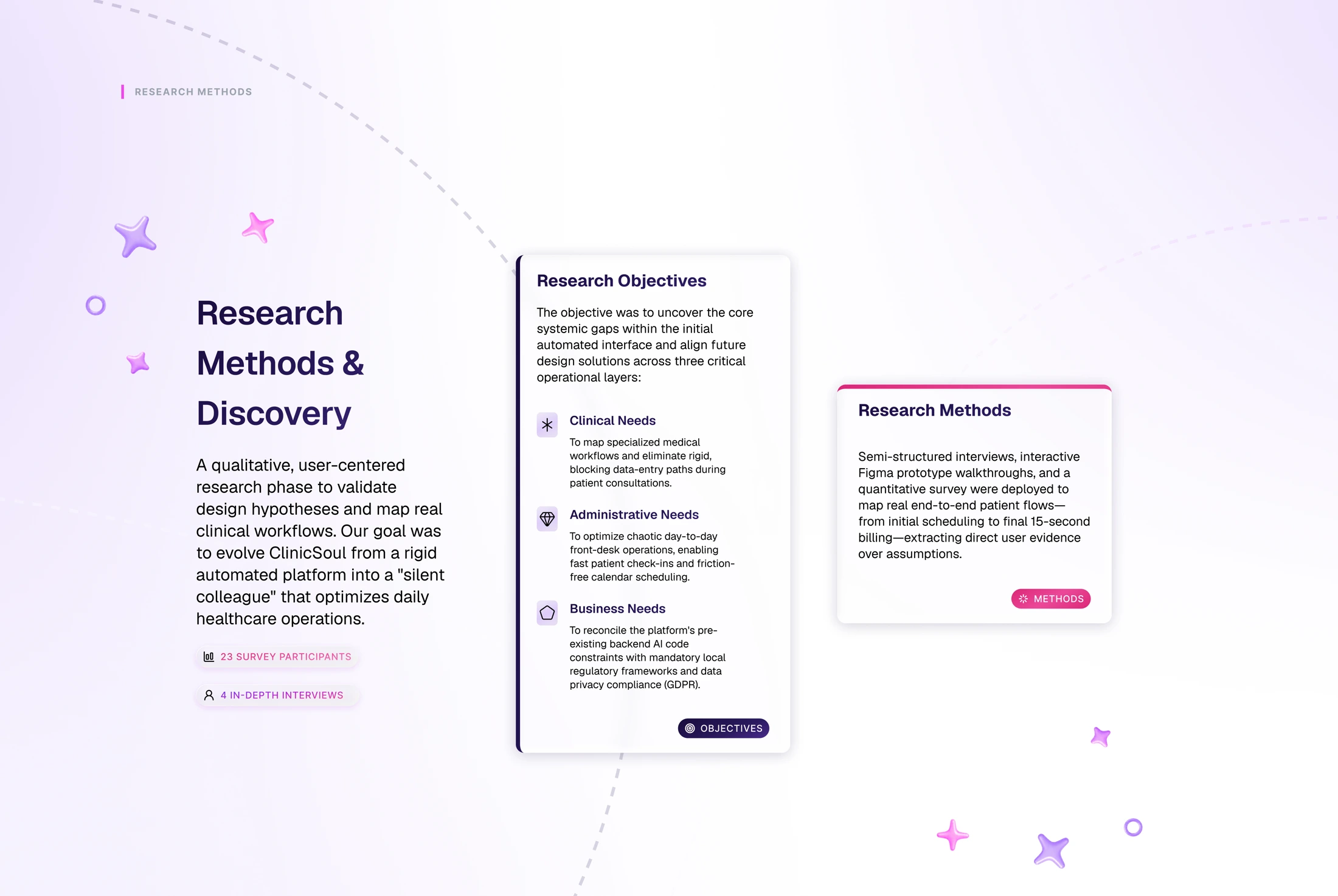
The team ran four semi-structured interviews and a survey with 23 participants. Interviews and recordings were analyzed with AI support (NotebookLM) to identify recurring themes.

Deliverables

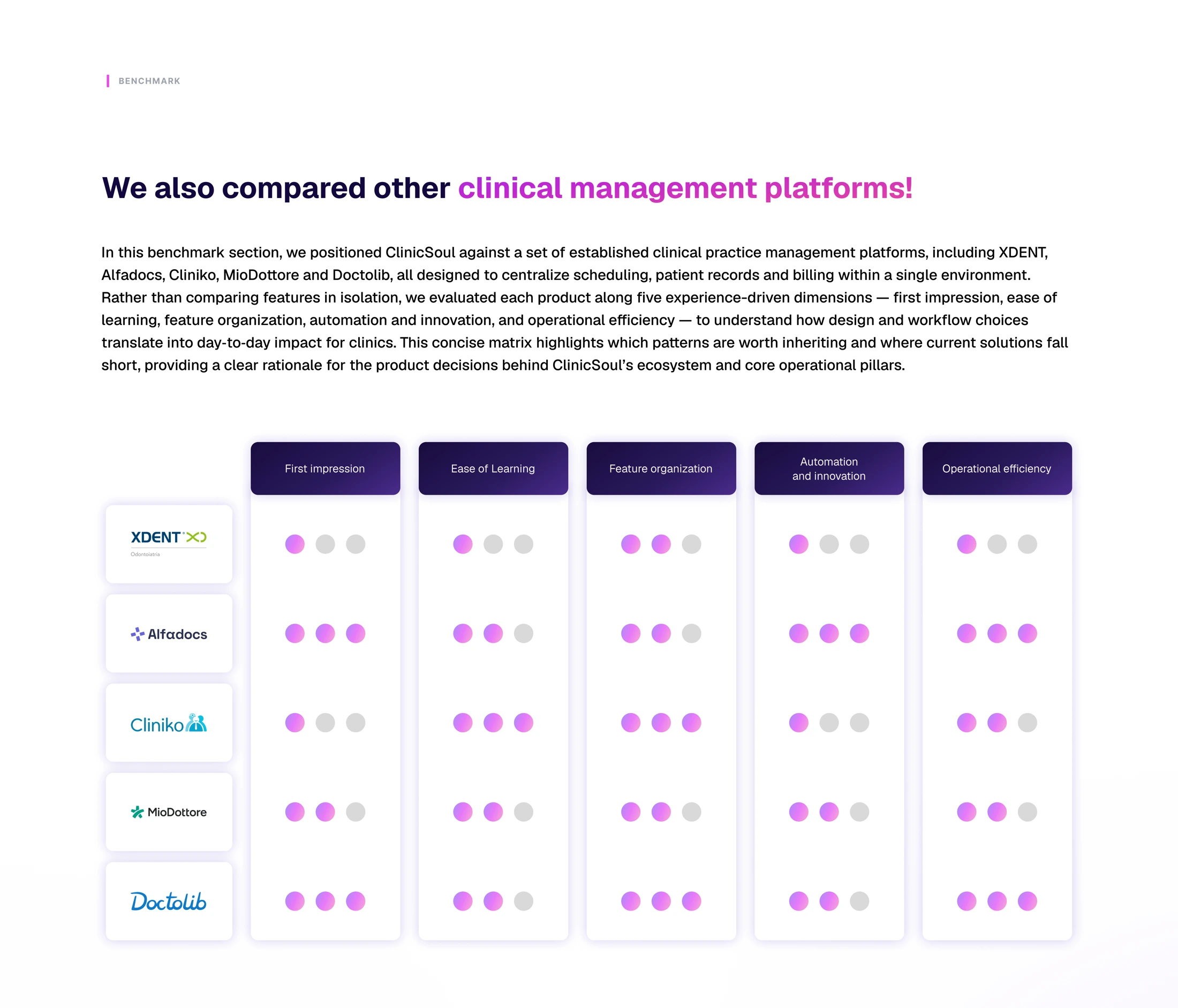
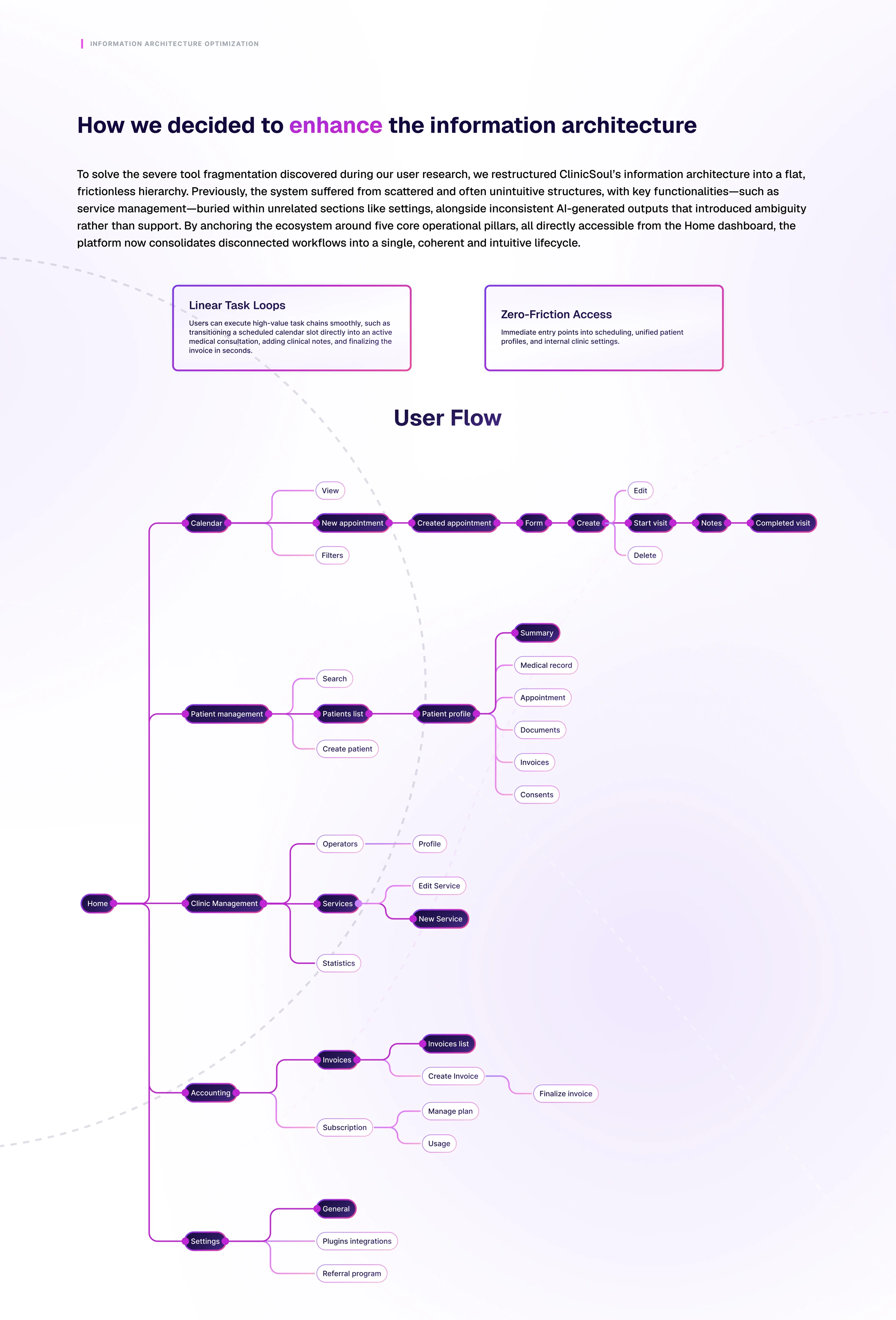
A complete restructuring of the information architecture around five operational pillars — Calendar, Patient Management, Clinic Management, Accounting, and Settings — plus a benchmark against five competitors: XDENT, Alfadocs, Cliniko, MioDottore, and Doctolib.
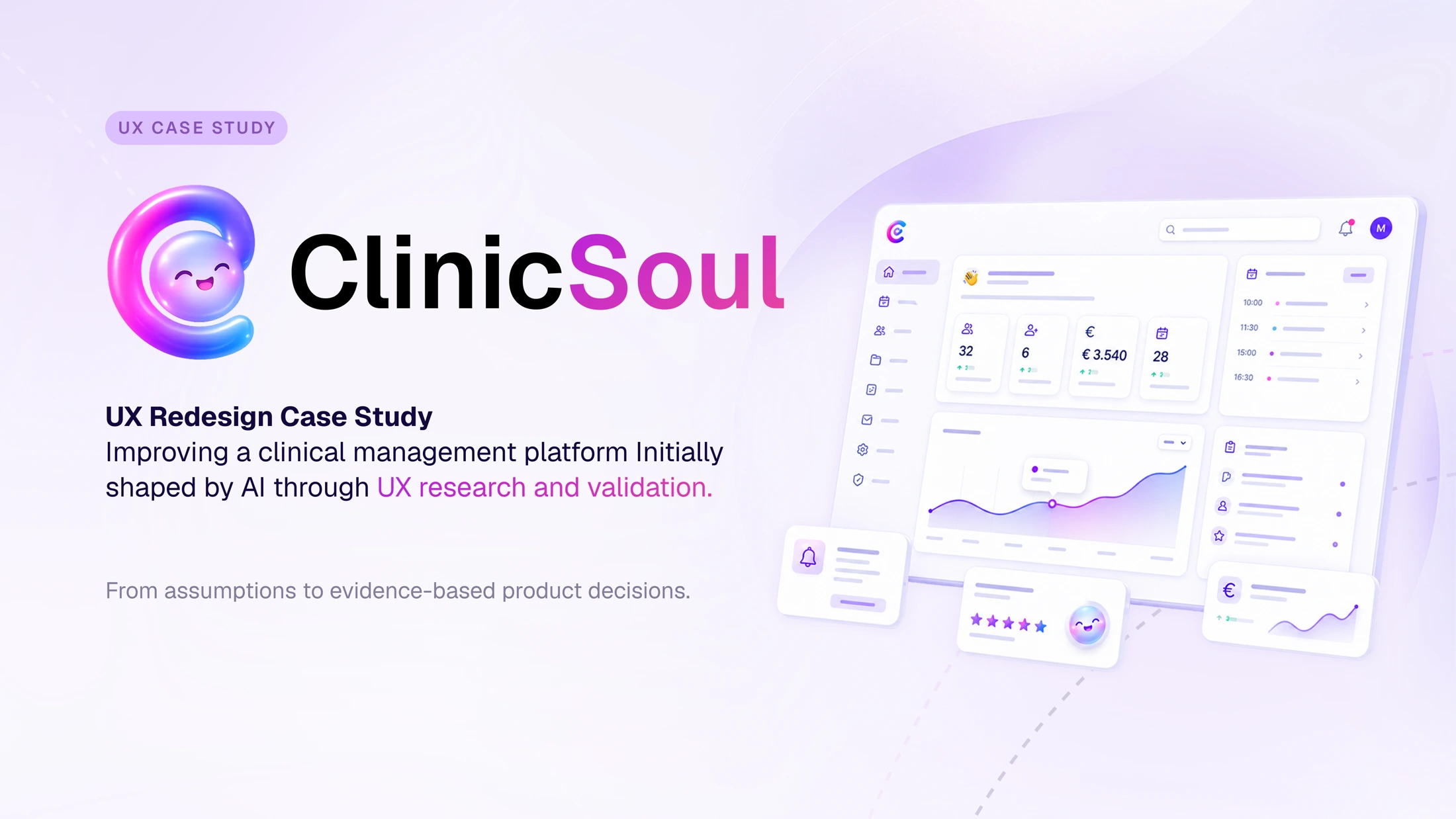
ClinicSoul hero slide: logo, 'UX Redesign Case Study' tagline about improving an AI-shaped clinical platform through UX research, and a dashboard screenshot with appointments and revenue metrics.
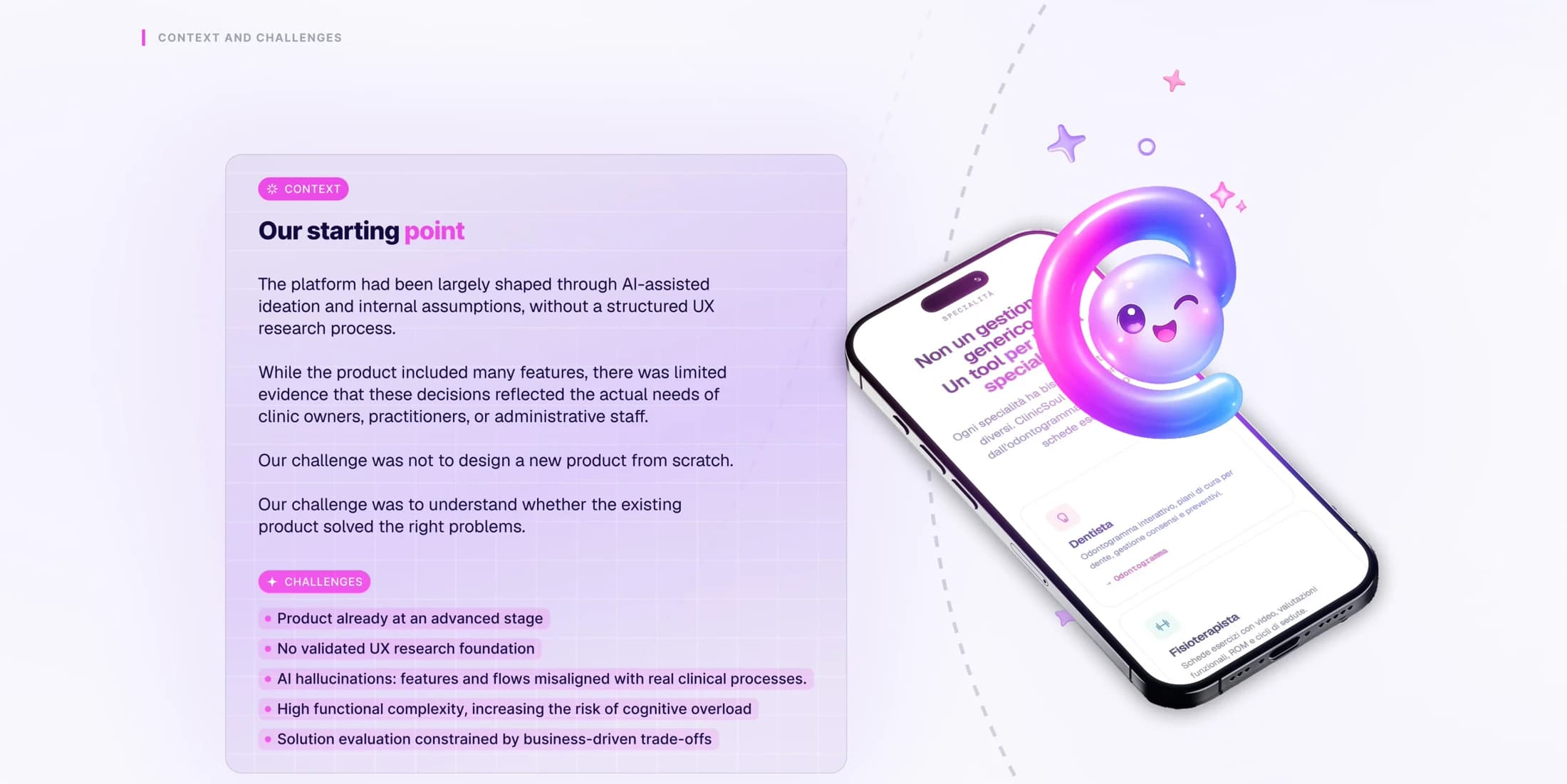
Slide on the project's starting point: the platform was shaped by AI-assisted ideation without a UX research process, listing the resulting challenges, next to a phone screen for selecting a clinical specialty.
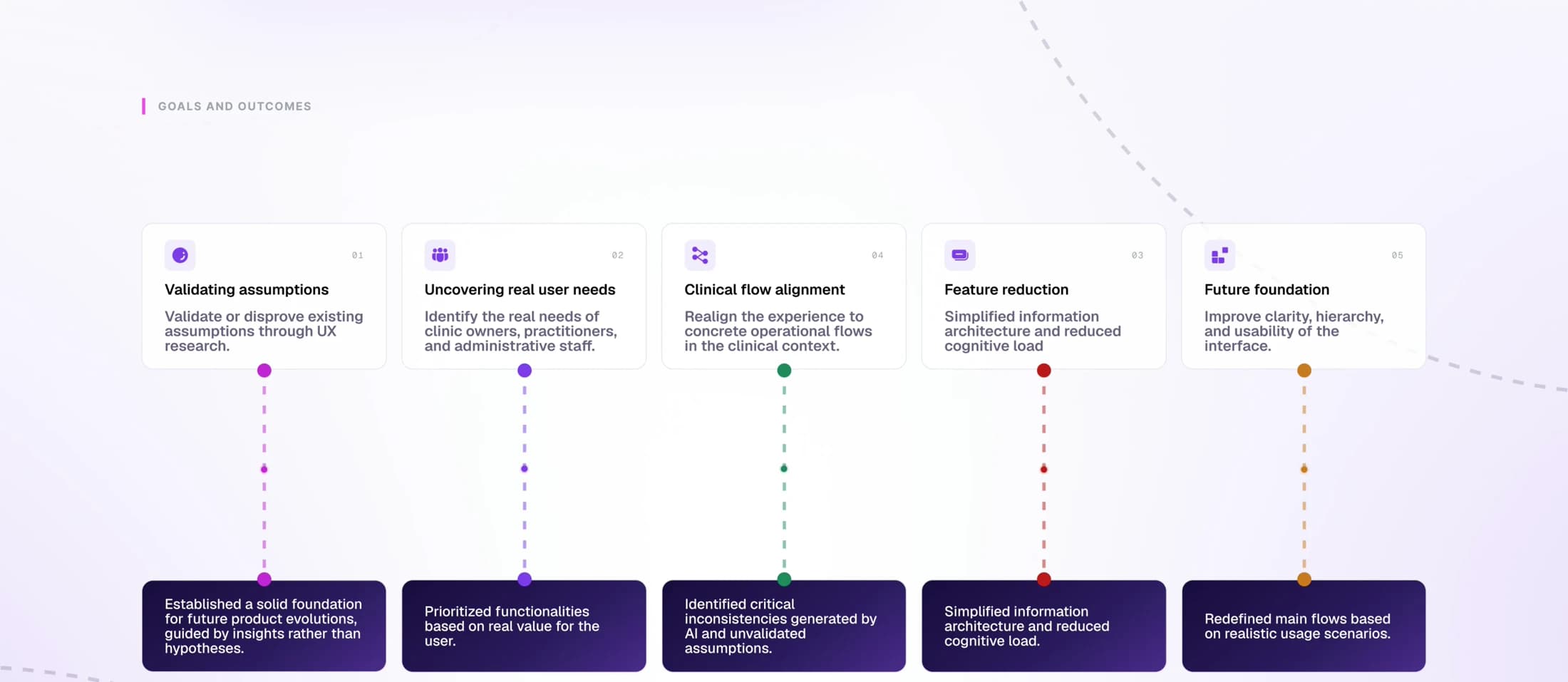
Goals and outcomes slide: five cards covering validating assumptions, uncovering real user needs, clinical flow alignment, feature reduction, and future foundation, each paired with its outcome.
Research methods slide: research objectives across clinical, administrative and business needs, the methods used (semi-structured interviews, Figma prototype walkthroughs, a survey), and the sample size of 23 survey participants and 4 in-depth interviews.
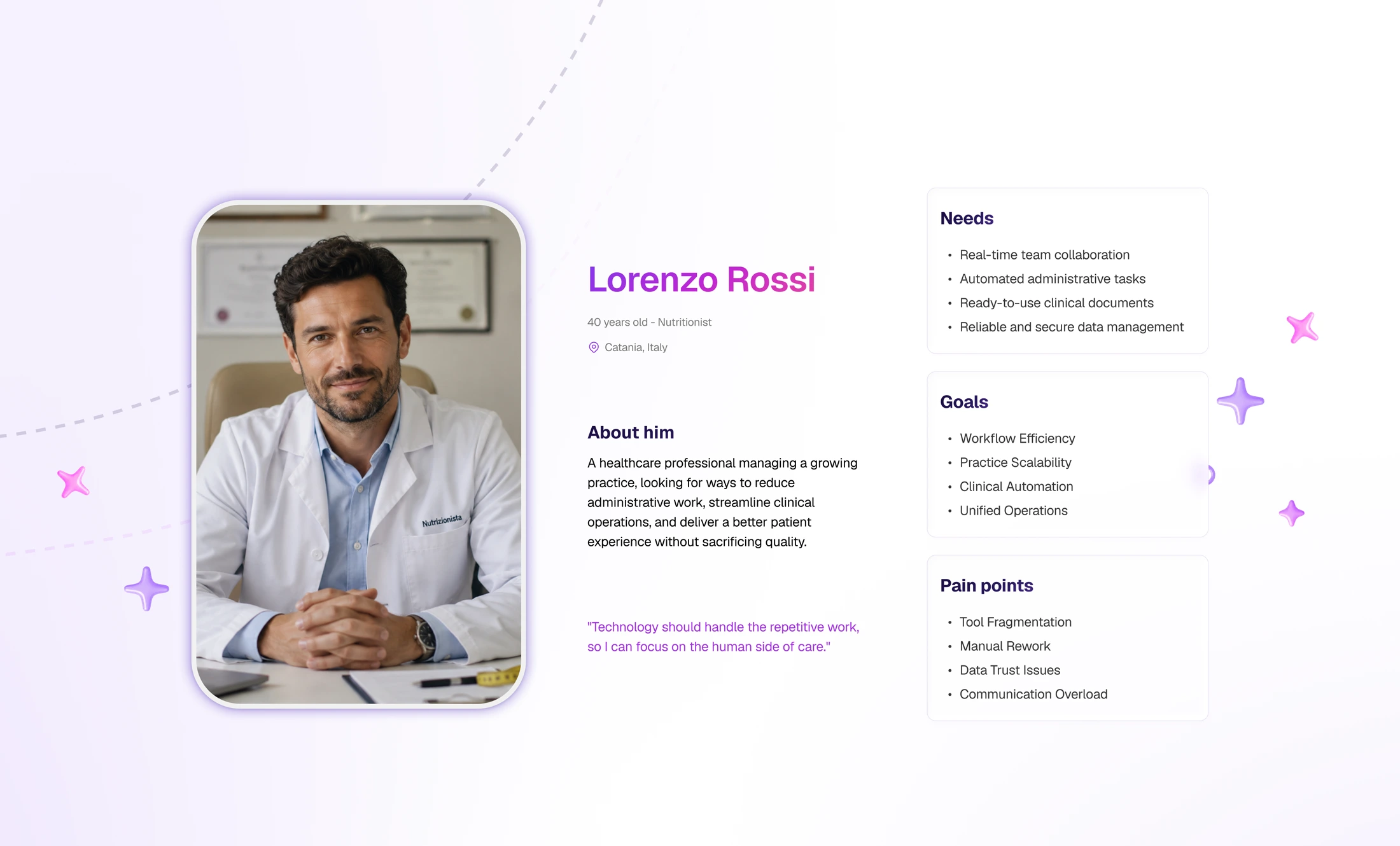
User persona 'Lorenzo Rossi', a 40-year-old nutritionist, with his needs, goals and pain points.
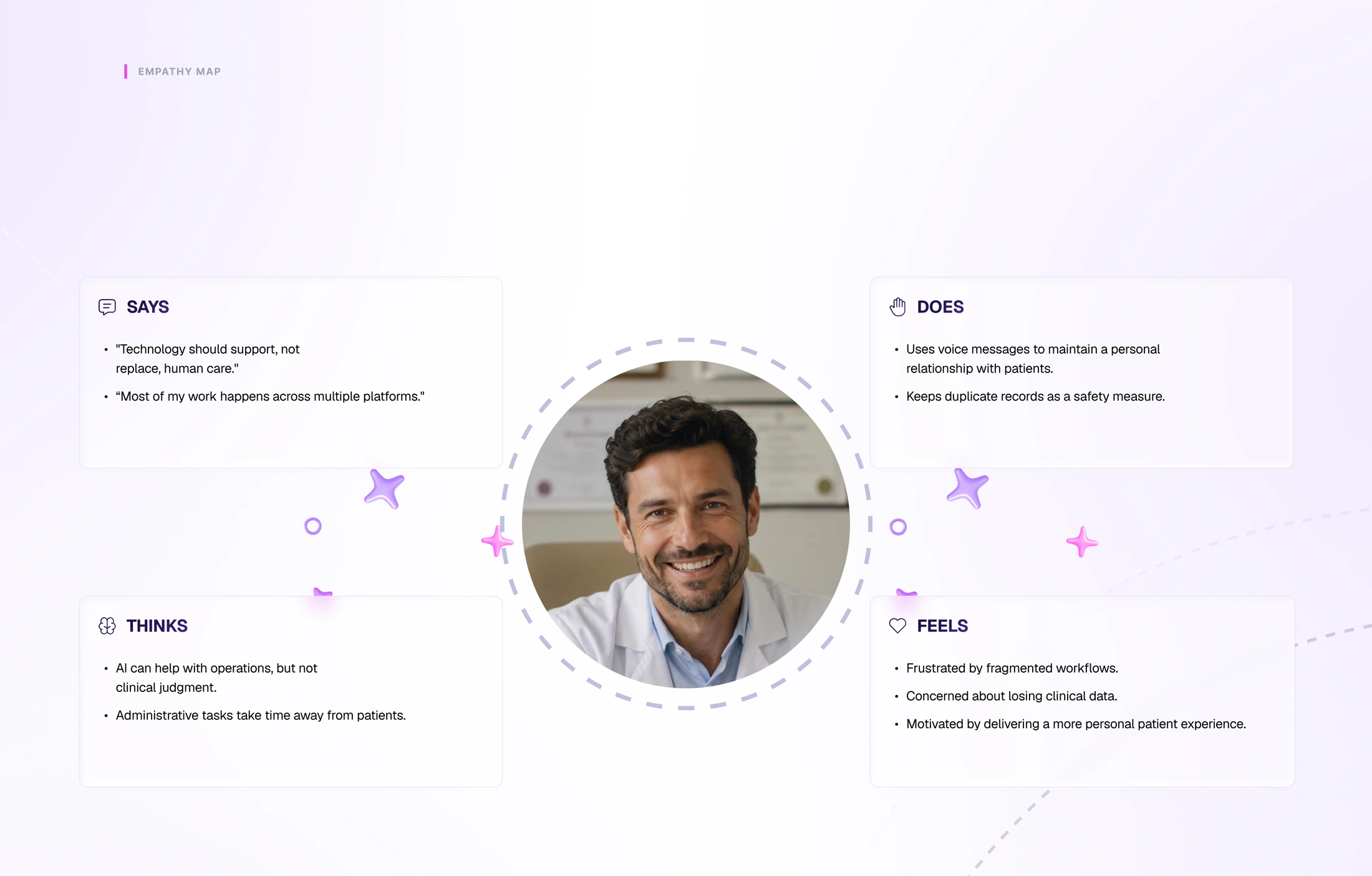
Empathy map for the Lorenzo Rossi persona, covering what he says, does, thinks and feels.
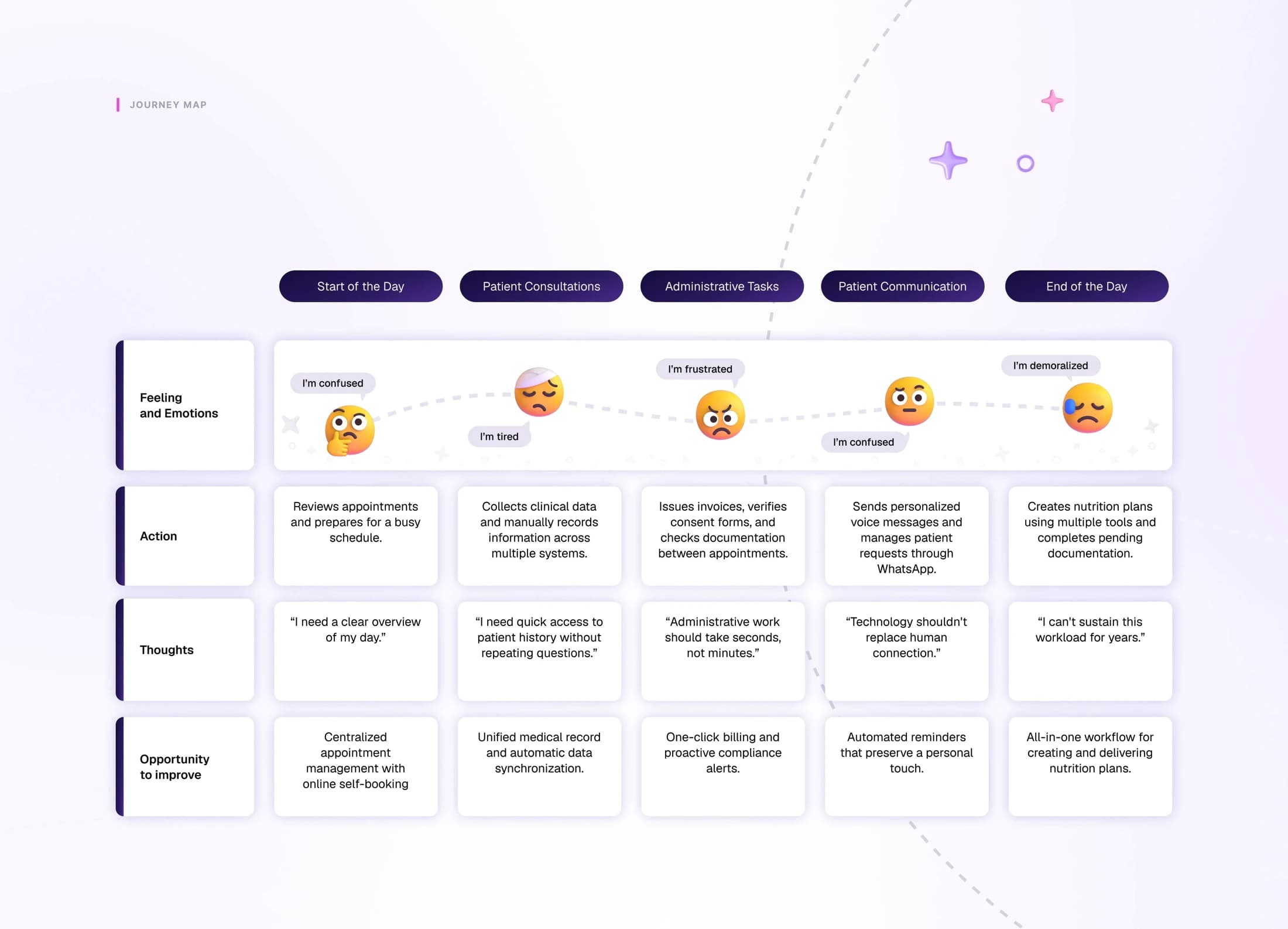
Patient journey map from start to end of day, showing feelings, actions, thoughts and improvement opportunities across consultations, administrative tasks and patient communication.
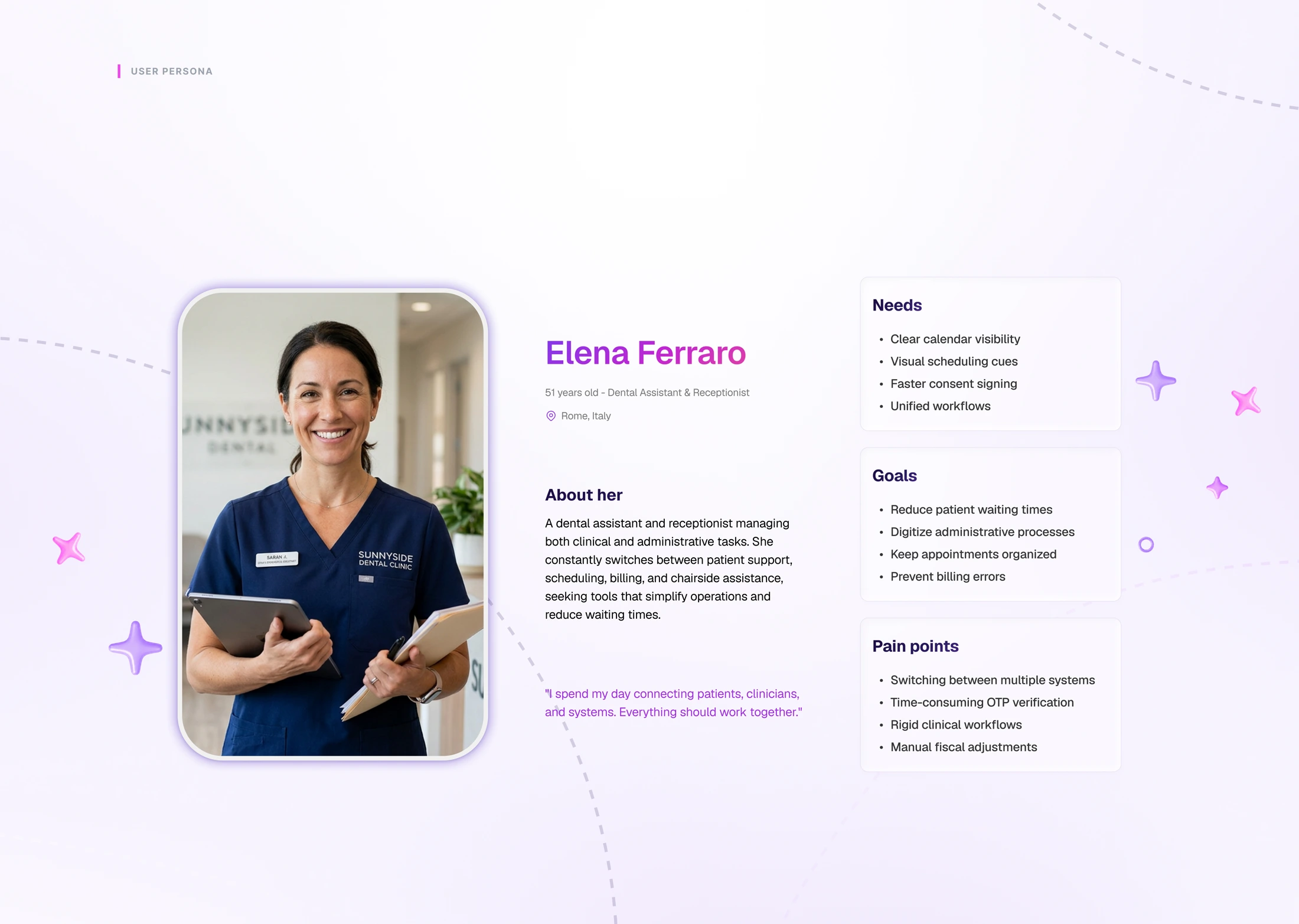
User persona 'Elena Ferraro', a 51-year-old dental assistant and receptionist, with her needs, goals and pain points.
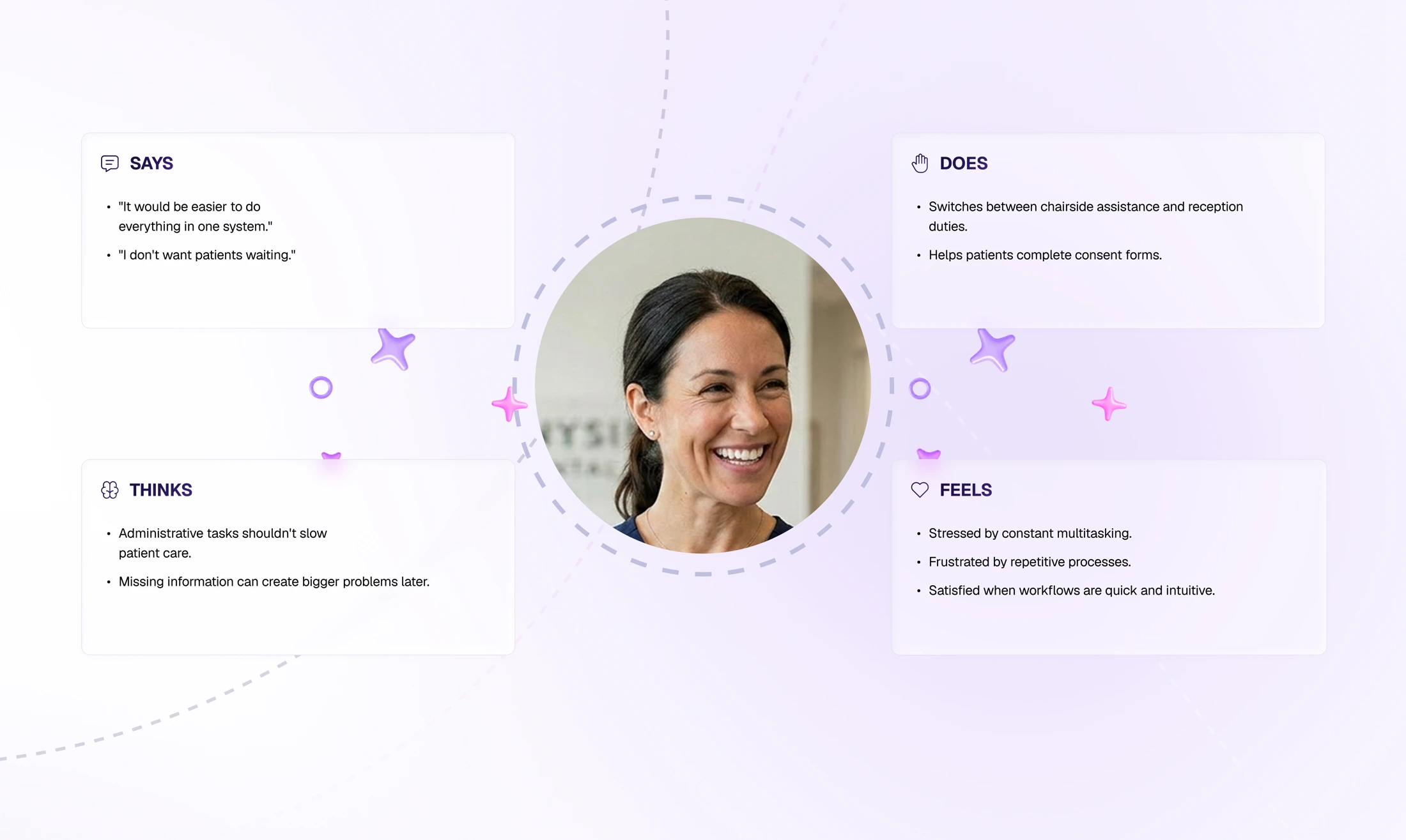
Empathy map for the Elena Ferraro persona, covering what she says, does, thinks and feels.
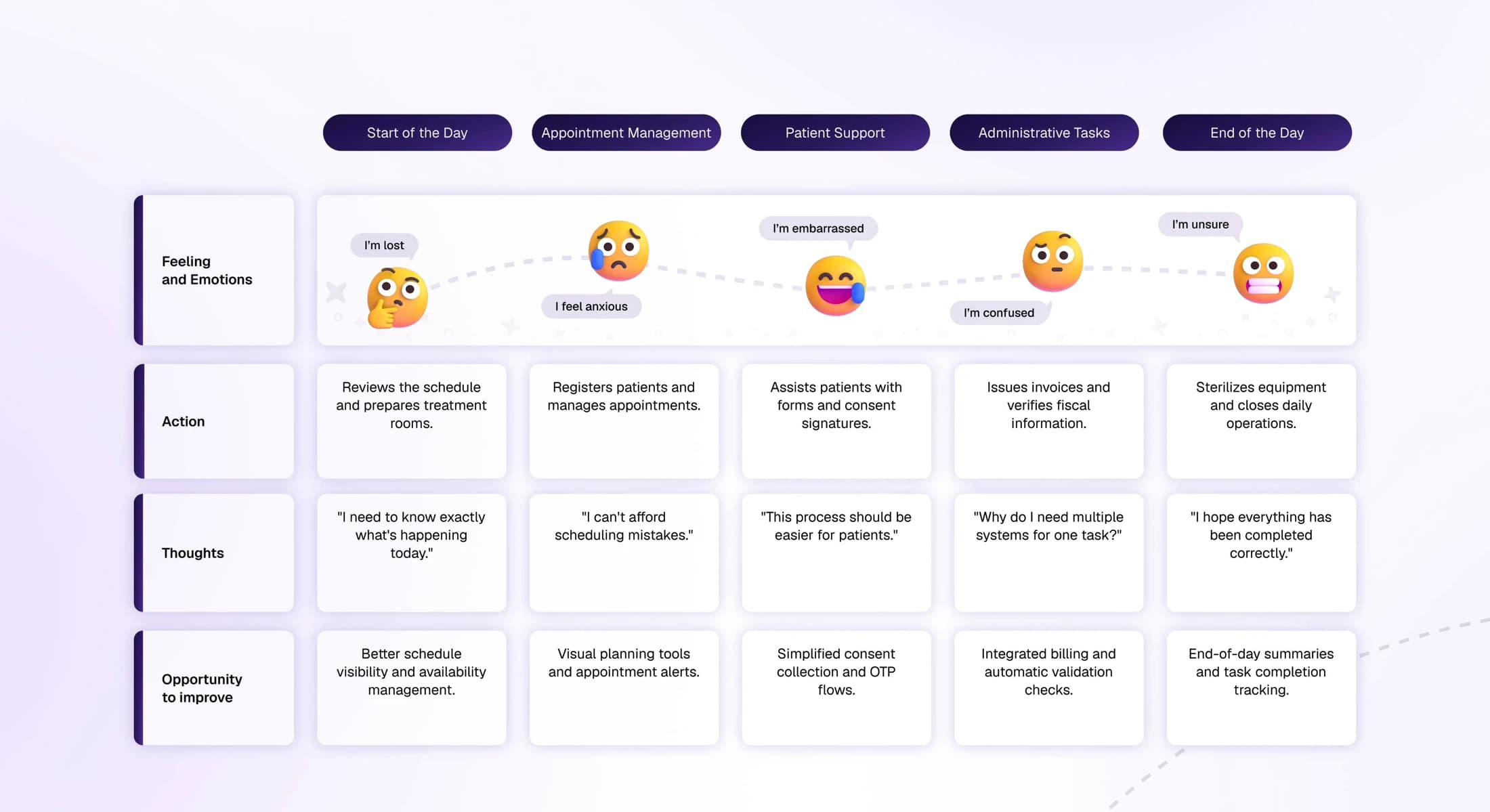
Second journey map from start to end of day, covering appointment management, patient support and administrative tasks with associated feelings and improvement opportunities.
Section intro slide: 'What did we learn from our users?', introducing the insights grouped into three main categories.
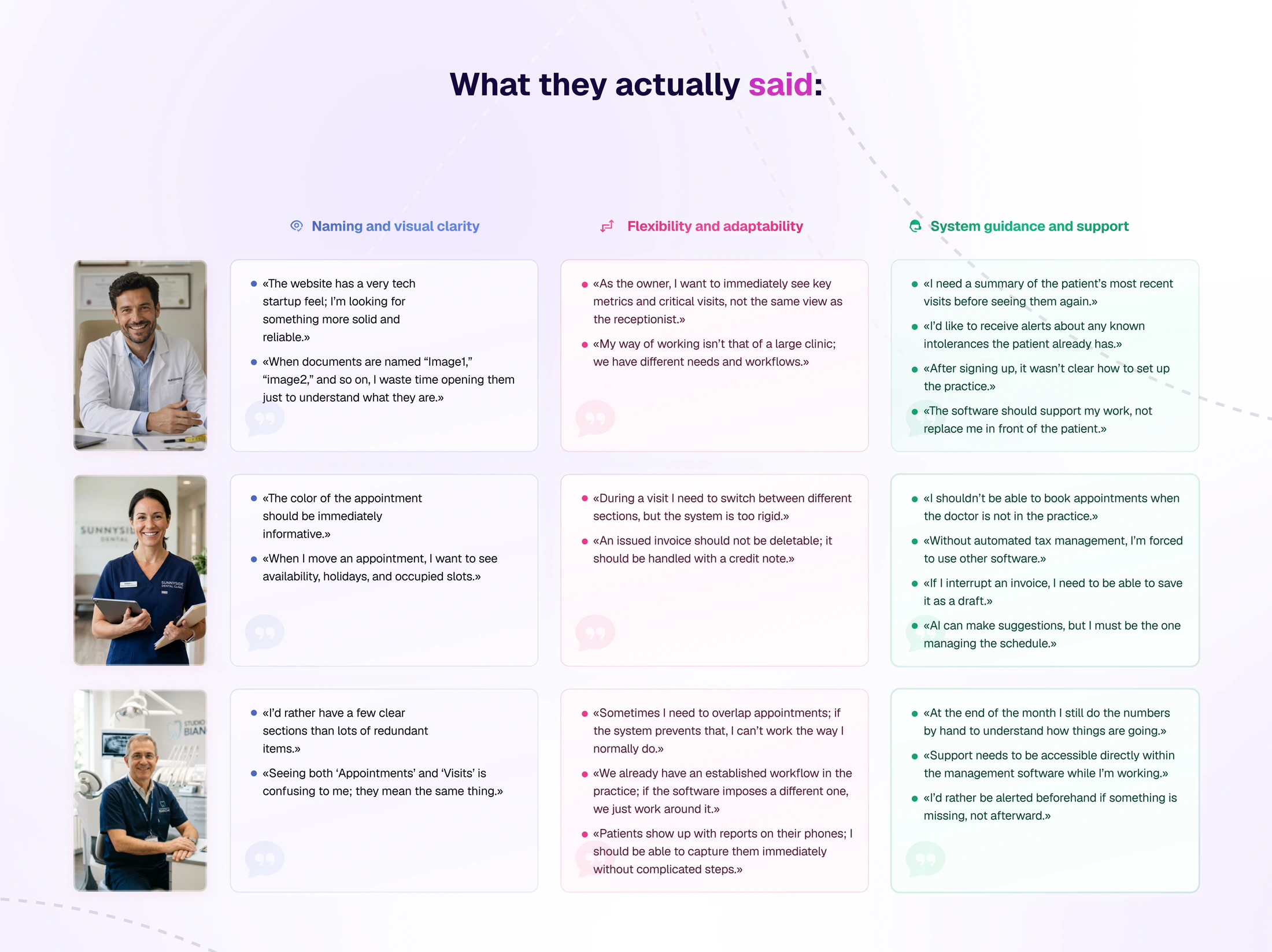
Direct quotes from interview participants grouped into three themes: naming and visual clarity, flexibility and adaptability, and system guidance and support.
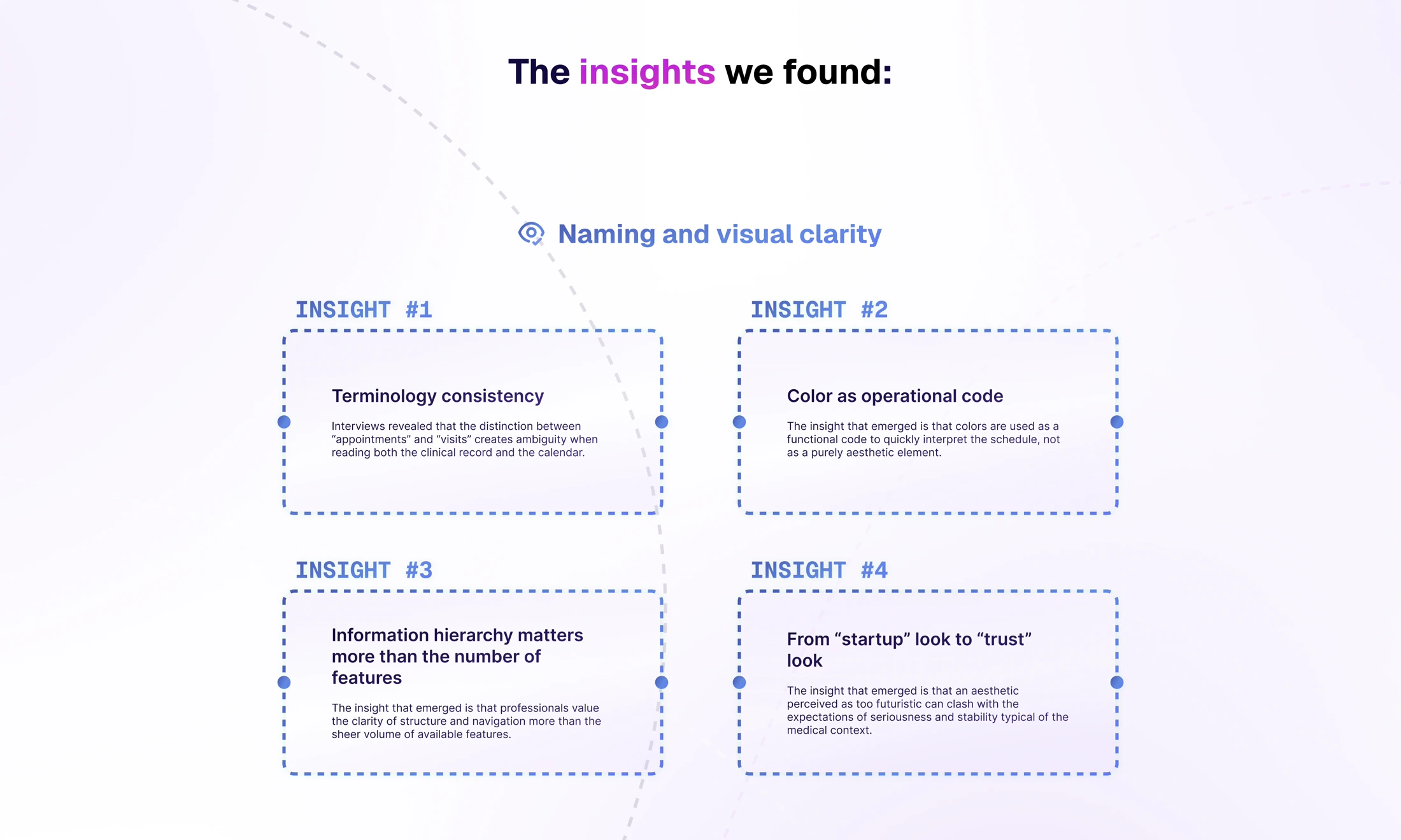
Four insights on naming and visual clarity: terminology consistency, color as operational code, information hierarchy, and moving from a 'startup' look to a 'trust' look.
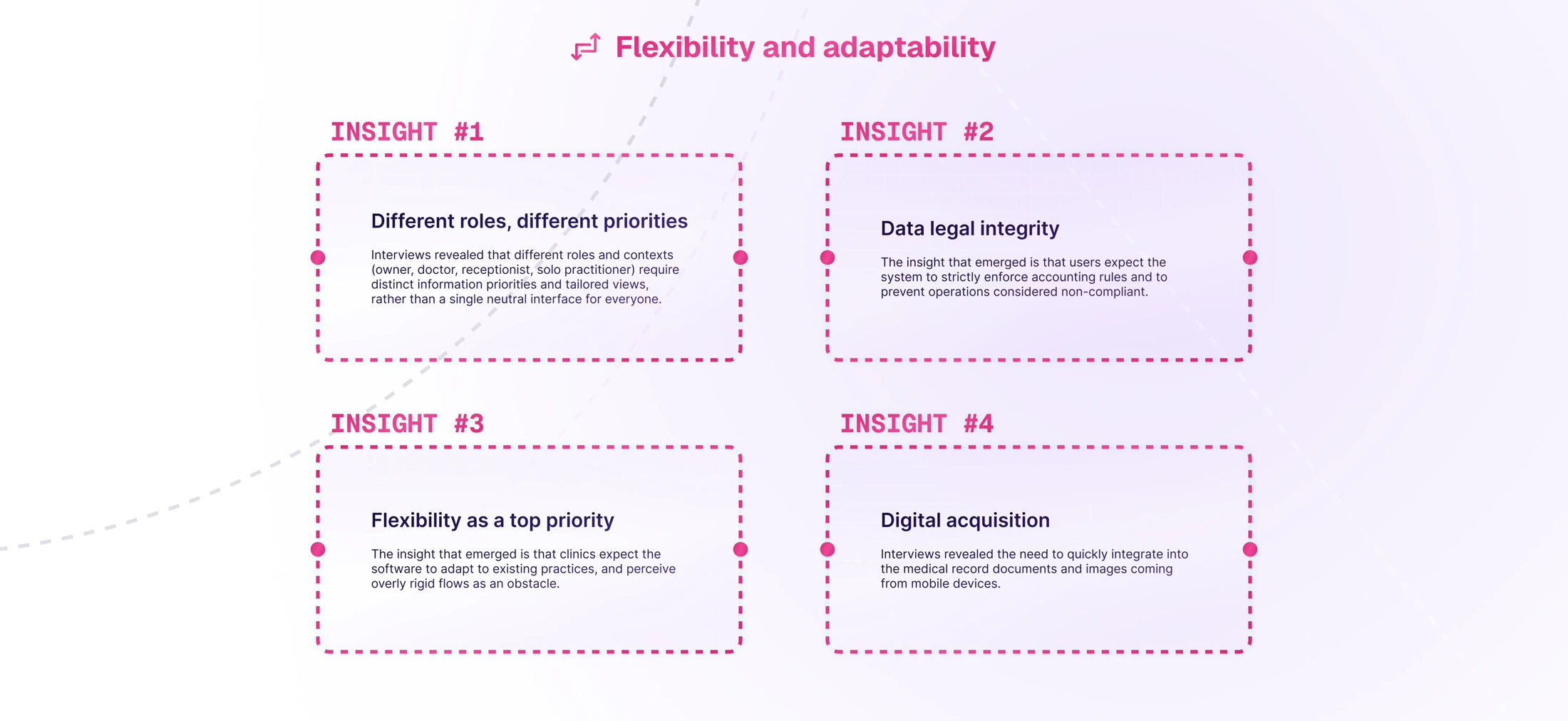
Four insights on flexibility and adaptability: different roles need different priorities, data legal integrity, flexibility as a top priority, and digital acquisition.
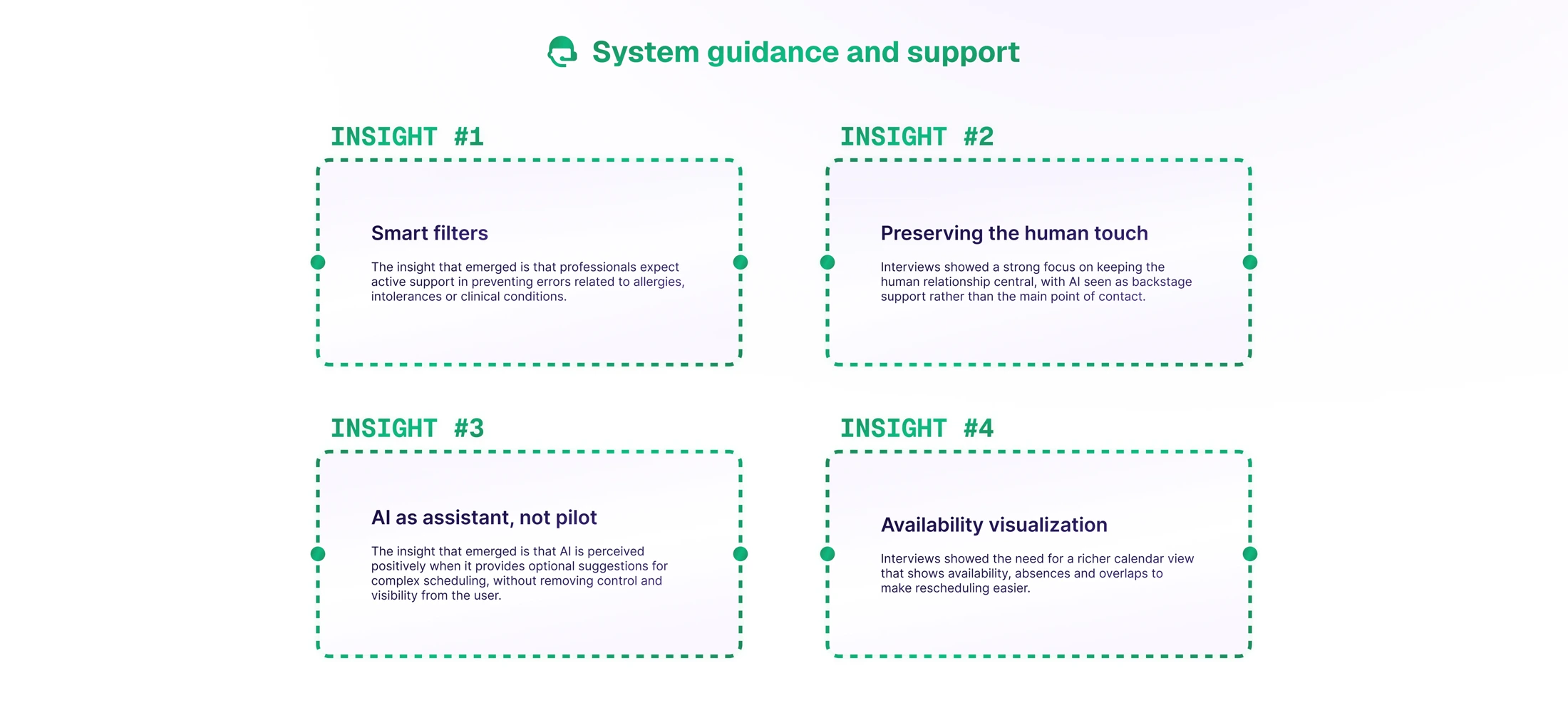
Four insights on system guidance and support: smart filters, preserving the human touch, AI as assistant not pilot, and availability visualization.
Benchmark matrix comparing ClinicSoul against five competitors — XDENT, Alfadocs, Cliniko, MioDottore and Doctolib — across first impression, ease of learning, feature organization, automation and innovation, and operational efficiency.
Information architecture diagram showing the redesigned user flow around five pillars: Calendar, Patient Management, Clinic Management, Accounting and Settings.
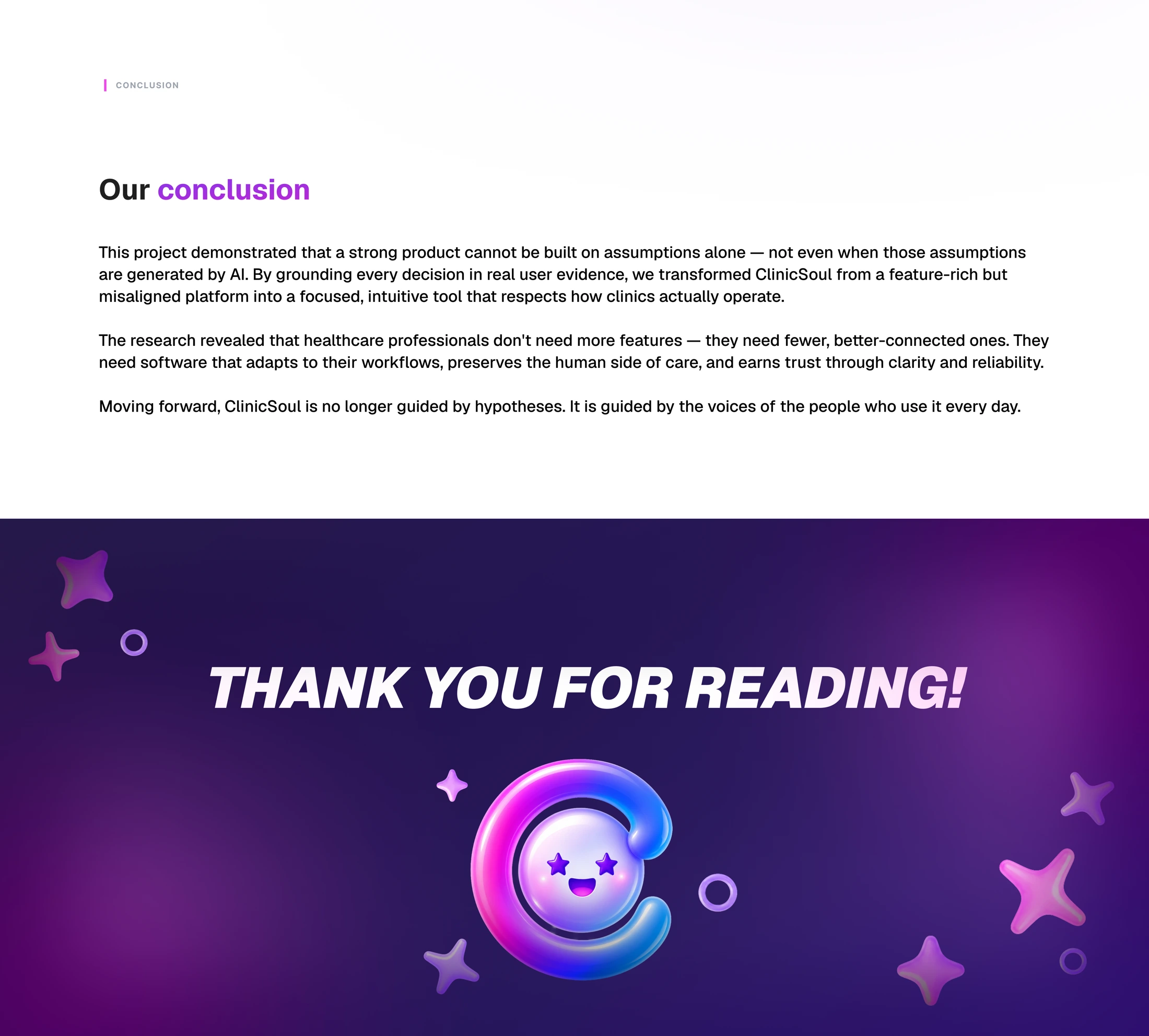
Closing slide: project conclusion on moving from assumptions to evidence-based decisions, followed by a 'Thank you for reading' slide with the ClinicSoul mascot.